
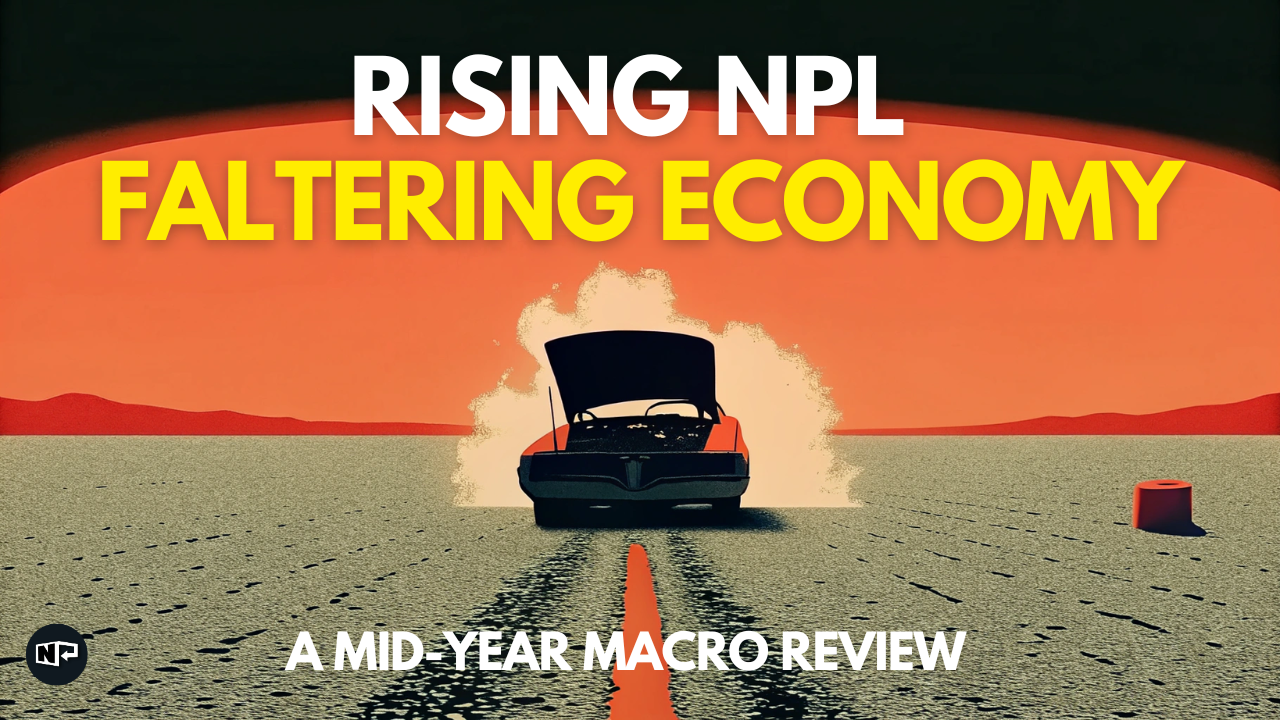
A Mid-Year Macro Review
Six months into the fiscal year, the economy feels like a well-worn car sputtering along a winding mountain road: there are glimpses of scenery, but the engine doesn’t inspire confidence. Beneath the surface of our economy lies a precarious mix of fragile recovery signals and deeply entrenched vulnerabilities.
Here are a few observations based on available data for six months of the current fiscal year (Data provided by npstocks.com and SMTM Capital):
1. NPLs: Not the Nepal Premier League
Eighteen out of twenty commercial banks reported bad loans exceeding 3%, 15 of those have crossed 4% and 4 banks have breached the regulatory threshold of 5%. The median NPL (non-performing loan) ratio of 4.88% is unprecedented, symptomatic of a financial system struggling under the weight of defaults.
The math of NPLs is straightforward but unforgiving: without new loans to dilute the share of bad ones, the ratio inevitably climbs when loans start turning sour. But the problem here is not just arithmetic; it’s systemic. As credit growth slows, defaults rise, creating a vicious cycle. Banks, gripped by fear, clutch their balance sheets, abandoning their role as intermediaries of credit, and stop disbursing loans. In Nepal’s case, excessive compliance and disclosure requirements have discouraged many from borrowing.
2. Merger Madness: Bigger Isn’t Always Better
Till now, the Central Bank’s policy of forced mergers has not shown positive signs. Alarmingly, all four banks with NPLs exceeding 5% are merged entities. Worse still, four other merged banks are teetering just below this mark, with NPLs above 4.9%.
Rather than creating stronger, more resilient institutions, these mergers appear to have merely clustered risk into larger, unwieldy packages. If bigger is better, it certainly hasn’t looked that way in the short to medium term.
3. YoY Credit Growth: A Flicker, Not a Flame
At first glance, year-on-year credit growth might seem like the lone silver lining: at 6.11%, it’s the highest in nine quarters. But before popping the champagne, it’s worth noting that this growth is slower than the first quarter and far below the government’s target.
Worse still, credit growth has stayed below 20% for 12 consecutive quarters, and for 10 of the last 12, it’s limped along at under 6%.
While the latest numbers suggest a glimmer of hope, the structural bottlenecks remain as suffocating as ever.
4. Capital Expenditure: Whats that?
Public capital expenditure stands at a paltry 16.2%, a glaring yet unsurprising underperformance for a country in dire need of investment-led growth. For an economy weighed down by stagnation, productive spending on infrastructure, industry, and energy should be non-negotiable.
Without a bold public investment push, the economy risks remaining stuck in a low-growth rut, where recovery is a mirage rather than a destination.
5. The Import-Remittance Balancing Act
Domestic production, sadly, remains on life support. Structural inefficiencies, supply chain challenges, and a lack of clear economic vision have left the country leaning heavily on remittances, which continue to rise steadily. Imports have grown 7% year-on-year, hinting at a modest uptick in consumer and industrial demand. But whether this is a sign of recovery or simply an imported consumption binge remains unclear.
A False Dawn or an Inflection Point?
The broader problem, of course, is the glaring absence of economic activity. Weak asset markets and stagnant output have created a vicious cycle and rising bad loans continues to feed off of the lack of growth. Compounding the challenge is the reality of the regulator’s misguided initiatives. The failure of forced mergers is just one example and underscores a key lesson: policy interventions must be tailored to local realities, with stakeholders’ needs prioritized.
The government has introduced a series of ordinances to “boost” the business environment. But is this the start of meaningful reform or just another symbolic gesture?
The modest increase in loan demand and the rise in imports could, in theory, be the first signs of recovery. But as Warren Buffett once quipped, "Only when the tide goes out do you discover who's been swimming naked." Right now, the fundamentals—poor governance, anemic public investment, and weak domestic production—suggest there’s a lot of skinny-dipping going on.


